Thursday, August 16, 2018

Music Provides a Personality Analysis using Successive Octaves

After being closed for approximately nine months for renovations, the General George Patton Museum of Leadership in Fort Knox, Kentucky reopens today. Many movies and television programs have explored the WWII general as a subject, but the most well-known is the 1970 film Patton with George C. Scott in the title role. Jerry Goldsmith's musical score for this film earned him an Academy Award nomination for Best Score. Goldsmith's score incorporates three distinctive musical ideas. One features a recording of two trumpets playing parallel perfect fourths in a triplet rhythm, which is then fed into an Echoplex, creating continuous and fading repetitions. While this idea is essentially a fanfaric motive, extended through reiteration, the other two ideas are bona fide themes: a spirited march and a slower-moving chorale. As Goldsmith explained in a 2002 interview, these three ideas represent different aspects of Patton's personality. The fanfare represents “the archaic part of [Patton], the historical, the intellectual part of him,” and the echo effect in particular reflects Patton's belief in reincarnation. More obviously, the march represents Patton's military side, and the chorale his religious faith.

In the interview, Goldsmith shared that he fashioned these three ideas “so that all three could be played simultaneously or individually or one or two at a time.” Given the fanfare's harmonic simplicity, its combination with either the march or the chorale is relatively straightforward. However, the merger of the march and chorale themes, which occurs both during the movie's main title and during the movie proper, requires more craft. The score below shows the two themes, how Goldsmith combines them in counterpoint, and the harmonic intervals that frame their contrapuntal interaction. (This music is transcribed in 6/8 (instead of, say, 12/8, or in 4/4 with triplets) to aid in its comparison to another famous simultaneity of two themes I will discuss on this blog a year from now.)


The fact that both themes basically arpeggiate tonic harmony for the first six of each eight-measure phrase (and dominant harmony for the last two) facilitates well-formed counterpoint. However, something about the combination contravenes classical tonal practice: measures 3 and 4 include successive octaves, as highlighted. This would be quite unusual to find in music from Bach to Brahms. One could interpret this succession as either faulty counterpoint, or counterpoint that has shaken off the shackles of classical rules. Or one's interpretation could instead espouse the idea that successive octaves undermine the autonomy of lines; therefore, the successive octaves in measures 3 and 4 subtly bring the march and chorale themes into a closer affinity with one another. This is consistent with Patton's biography, according to historyonthenet.com: "To Patton, prayer was a 'force multiplier'—when combined with or employed by a combat force, it substantially increases the effectiveness of human efforts and enhances the odds of victory. In this sense, prayer was no different from training, leadership, technology, or firepower."

Monday, July 2, 2018

Tables Turn in an Atypical Place in Bach's Music: R and I (Part V)

295 years ago today, Johann Sebastian Bach premiered his cantata Herz und Mund und Tat und Leben (BWV 147) in Leipzig. Each of the two parts of the cantata ends with a movement based on the Lutheran chorale tune "Werde munter, mein Gemüte," shown below.


The music for these two movements is well known today in instrumental settings with the name "Jesu, Joy of Man's Desiring." Here are the first five measures for these two movements.


One does not need to analyze deeply the famous stream of eighth notes to find within it the chorale tune's opening three notes (B-C-D), as shown below: they occur on beats 2, 3, and 1 in mm. 1-2.

The B-C-D progression—also on beats 2, 3, and 1—also occurs in the bass in mm. 3-4, as shown on the bottom of the full score provided above. In fact, these two pairs of measures enjoy a closer relationship. Below are just the soprano and bass onsets for these six beats. The first six notes, if retrograded and diatonically inverted around middle C, becomes the next six notes. The inverted clef and signatures at the end of the system also indicate this: if you turn this figure 180°, it looks exactly the same.


A "table canon"—whereby a line of music is placed on a table in between two performers, who read it from either side—also contains this kind of symmetry. This reduction of Bach's music could be performed by placing either of the two lines above on a table between a treble performer and a bass performer.

Tuesday, June 12, 2018

A Hidden Unflippable Pattern, via Schenker, in “Happy Birthday To You”: R and I (Part IV)

On this day 22 years ago (1996), "Happy Birthday to You" was inducted as a "Towering Song" into the Songwriters Hall of Fame, whose website reports that, on this day 125 years ago (1893), this song was first published, although it was only the music that was published in this year: the words probably came later.

The music for "Happy Birthday to You" lends itself well to the initial stages of teaching Schenkerian analysis, as can be seen in the fine Reddit post by "Xenoceratops" here, and its accompanying analysis here. A couple of years ago in this blog, I said that Schenkerian theory "distills tonal structures to their linear-harmonic essence, where prominent starting notes and normative cadential notes are stitched together into a well-formed contrapuntal design." It is a complex theory to learn and teach, but it can be as rewarding as it is complex. Here I offer a method to (somewhat) automate the application of the theory, a way that some might find crude, but it nonetheless matches competent analyses in some, perhaps even many, cases. It also reveals a hidden symmetry in this music's linear-harmonic structure that, consistent with my last three posts, involves a combination of retrograde and inversion, as shown at the end of this post.

The method begins with a triadic reduction of the music. Here is the melody for "Happy Birthday to You" in F major, along with a simple and common bass line and a standard triadic harmonization of this bass line. The number of chords in this harmonization, which I will abbreviate as #c, is seven. (I have considered the cadential 6/4 chord as a separate chord; another approach might elect not to do so.)


The next step is, within certain constraints, to write out (or at least imagine) all the possible realizations of this harmonic progression using three upper voices -- soprano (always highest), alto (always second highest), and tenor (always second lowest) -- each making a four-part chorale-style composition. (A simple keyboard accompaniment that one is likely to play when supporting the singing of this tune is likely to be one of these realizations.) The constraints are as follows:

1) For every triad, the three voices should collectively cover its three members.

2) With each motion from from triad to triad, the three upper voices should all either upshift or downshift. Xshifting (X = up or down) means that a voice either stays on the same note or moves X either by second or third.

There are exactly 6*(2^(#c-1)) realizations, starting octave position aside, because there are six possible assignments of the first triad's three notes to the three voices of soprano, alto, and tenor, and there are #c-1 instances when a triad voice-leads to the next triad, and each voice-leading may be an upshift or a downshift. In the case of "Happy Birthday to You," #c is 7; therefore, the number of realizations is 6*64, or 384. However, for the purposes of emulating Schenkerian analysis, it only matters to which triadic member the first soprano pitch is assigned; therefore, we need only concern ourselves with half this number, or 192 realizations.

For example, the first realization below starts the soprano on the third, and alternates back and forth between upshifting (u) and downshifting (d), and the second realization starts on the root and constantly upshifts. This first realization could be abbreviated as 3-ududud, or 3-42: 3 is for third, and, if u is 1 and d is 0 in ududud, then the resulting base 2 number written in base 10 is 42. The second realization could be abbreviated as R-uuuuuu, or R-63.

3-42

R-63

These are two of the 192 realizations of interest. These 192 realizations provide 192 different soprano lines. One way to emulate a Schenkerian analysis of "Happy Birthday to You" is to choose one of these 192 soprano lines that is most like, or best represents, the melody. This soprano line then becomes what is called the Urlinie, or fundamental treble line, in Schenkerian theory. One way to quantify the degree of this resemblance or representation is to choose a soprano line that maximally overlaps with the melody, regardless of the octave placement of the notes. For example, the two figures below show that the soprano line of realization 3-42 overlaps with the melody of "Happy Birthday to You" for a total time of five quarter-note durations, and the soprano line of realization R-63 overlaps with the melody of "Happy Birthday to You" for a total time of six quarter-note durations (four quarter notes plus a half note at the end).

3-42 plus overlap with melody

R-63 plus overlap with melody


Surely we can do better than five or six. The two realizations with the most overlap of ten quarter notes are 5-duuudu, or 5-29, and 5-dudddd, or 5-16, as shown below. Among adaptations of Schenkerian theory where the Urlinie is allowed to ascend, or skip, or change direction, the Urlinie of 5-29 might find quarter. However, in orthodox Schenkerian theory, an Urlinie may only descend by step. If, in this case, we further restrict ourselves to realizations with soprano lines that only descend, or only move by step, or never change direction, then the soprano line of 5-16 is the only one with maximal overlap.

5-29 plus overlap with melody

5-16 plus overlap with melody

The last step is to choose a registral realization of 5-16 that maximizes registral overlap with the melody. The examples below show that starting the soprano on the C above middle C creates an overlap with a total time of six quarter-note durations, instead of the four quarter-note durations if the soprano started on middle C. This soprano line, in both its content and pacing, matches the Urlinie of the aforementioned analysis by "Xenoceratops" here, and the Urlinie that I suspect most Schenkerian analysts would choose.


This emulator could be refined by, for example, avoiding realizations with parallel perfect fifths or octaves (for example, toward the end of R-63 above), or weighting the overlap through the consideration of accented notes, non-chord tones, cadential notes, etc. With these refinements (but perhaps even without them), I suspect that this emulator would be able to demonstrate an important theoretical component of Schenker's project. If one runs this emulator on thousands of musical phrases that end on tonic harmony written by Western composers from 1720 to 1890, I speculate that a plurality of chosen soprano lines will descend by step to ^1, and the majority of chosen soprano lines will at least end with ^3-^2-^1. Thus the preference for 5-16 over 5-29 exercised earlier reflects a norm-based bias.

Lastly, a hidden symmetry of "Happy Birthday" shows itself when all of the chord tones are labeled, as shown below, by their assignment to soprano, alto, and tenor according to the realization of 5-16. This makes more evident the Schenkerian notion that, for example, the descents in mm. 5-6 and m. 7 are descents "into an inner voice." Inner-voice notes actually higher than adjacent soprano-voice notes due to octave equivalence—like the "tenor" note in m. 1 or "alto" note in m. 3—are what Schenker calls "superpositions" or "cover tones."


This labeling also reveals an invariance of structure. Imagine an inversion, defined on three upper voices, whereby alto (A) and tenor (T) switch places within triadic harmony, but the soprano (S) maintains the same triadic position. The sequence of voice assignments of the melody from "Happy Birthday to You"—STSATSATSAS—is thus a retrograde and this inversion of itself, just like the passages from Four Last Songs and The Aristocats mentioned in earlier posts are retrogrades and pitch-(or pitch-class-)inversions -- that is 180° flips -- of themselves: they are unflippable in the same manner than Messiaen's palindromic rhythms are non-retrogradable.

STSATSATSAS              -->                     SASTASTASTS               -->                    STSATSATSAS

                (inversion: A and T switch places)             (retrograde: sequence is flipped in time)

The fulcrum of the retrograde is also in the center of the melody.

Tuesday, May 22, 2018

Two Measures of Strauss’s "Spring" Twice Reflected: R and I (Part III)

The Four Last Songs of Richard Strauss (1864–1949) were composed 70 years ago this year, and were posthumously premiered on this day 68 years ago. One of the songs, entitled "Frühling" ["Spring"], repeatedly uses a distinctive four-chord, four-voice progression at different transpositional levels. The figure below includes a transcription of the first instance of this progression in the song. Some of the notes have been enharmonically respelled from Strauss's original score so that the each chord's notation clearly reflects its harmonic quality: Chord 1 is a minor triad, Chords 2 and 3 are minor seventh chords, and Chord 4 is a major triad. The vocal line follows the top notes, but the words have been omitted. I am considering Chord 4 as essentially a B-major triad in second inversion with the F-sharp eventually on top; therefore, I am treating the G sharp, presented below using a smaller font, as a non-chord appoggiatura.


In the picture above each chord, the chord's four notes -- register ignored -- are arranged onto a circle of half steps with C# at the top and G at the bottom, and then a polygon is inscribed within the circle using the notes as points. The notes that are doubled -- the A flat in Chord 1, and the F# in Chord 4 -- are indicated with the double curves.

In short, the progression of Chords 1 and 2 is both inverted around the axis C#/G (shown with the red arrows) and retrograded (shown with the green arrows) to produce the progression of Chords 3 and 4. Even the doubling of notes is preserved in this double transformation. The figure demonstrates this visually by inserting a mirror in between Chords 2 and 3. Whereas my two visualizations of both retrograde and inversion used earlier in this blog took place in two dimensions — the vertical depiction of registral pitch and the horizontal depiction of time — here the use of circular pitch-class space accommodates both transformations as reflections in a single dimension. The double-tipped black arrows, each labeled with a duration, shows that the mirroring of the onsets of the chords is also exact in time.

Lastly, Chords 2 and 3 are related not only by inversion but also by a 60° rotation; that is, a whole-step transposition (again, with register ignored). This is the same composite relation I showed three months ago in Schoenberg's op. 19 no. 4.

Sunday, April 1, 2018

Chords Flip in Pfitzner’s String Quartet in C-Sharp Minor: R and I (Part II)

The German composer Hans Pfitzner met Adolf Hitler early in 1923, and according to Michael Kater's account in Composers in the Nazi Era: Eight Portraits (Oxford, 1999), Hitler was not impressed. When Pfitzner learned of Hitler's internment in Landsberg later that year, Pfitzner hoped to reconnect with Hitler. He bought Hitler a book that he hoped would inspire him, and inscribed in it the dedication "To Adolf Hitler, the great German" and dated it April 1, 1923: 95 years ago today. Pfitzner never sent the book.

Among his chamber works, Pfitzner's Second String Quartet, op. 36, written in 1925, received special admiration. According to Kater, Paul Hindemith sought to premiere the work with his Amar Quartet. Arnold Schoenberg’s composition student Winfried Zillig was particularly impressed by the chromatic boldness of the work. The modernist journal Melos, when recognizing Pfitzner as a contributor to New Music, singled out this work and its similarity to recent works of Schoenberg, who was a couple years into his serialist period.

Pfitzner would have chafed at this comparison: he disdained the twelve-tone method. Nonetheless, two harmonic-progression pillars in the first movement of his op. 36 demonstrate -- with a little manipulation -- a retrograde-inversion (RI) relationship, a kind of musical transformation that musicians most readily associate with Schoenberg. The grand-staff reduction below shows both the movement's opening thematized chord progression in C-sharp minor, and the exposition's final cadential arrival in the relative key of E major. The four lines match the expected four quartet performers from top to bottom.


The graphic below shifts these pitches from the diatonic staff to a chromatic grid: the small numbers show when these notes occur using the measure.beat form. It simplifies and moves an octave higher the cello part of the cadential music. It also aligns the cello's C#-E resolution with the resolutions in the other parts. With these rather modest transformations, this cadential progression is a retrograde and inversion (a 180° flip) of the opening chord progression: the two stacks of notes and intervals on the left -- when fused together and turned 180° -- match the two stacks of notes and intervals on the right, allowing for enharmonic equivalence. The instrumental assignments do not follow the flip, but the flip does preserve registral arrangement, which is a more precise kind of RI relationship than the typical Schoenbergian flip.


Here is the answer to last month's crossword:


Thursday, March 1, 2018

The Aristocats Perform a Half Turn: R and I (Part I)

In 1970, Disney released its twentieth animated movie The Aristocats. (The children's book based on the movie was released thirty years ago this month.) Besides the title song, the only other song of the many songs written by the Sherman brothers that made it to the final cut of the movie was "Scales and Arpeggios." In this Mozartean tune, the cute kittens Marie and Berlioz practice their solfège ("do-mi-sol-do...") and piano playing together in their upscale maison in Paris. (No cat on cornet at this point.) In the third verse, their mother, Duchess, joins Marie in song. On the third-verse line, "like a tree, ability will bloom and grow," Marie and Duchess sing the first vocal harmony in the song. The graphic below shows the two lines so that the syllables of the lyrics match up with the pitches of the tune. (C4 is middle C.) Duchess sings the orange notes, while Marie sings the green notes. The two-tone squares represent the two moments when Marie and Duchess sing the same pitch at the same time.
The notes inside the 7x7 square in the upper right display a special property. If one takes the Duchess's orange notes inside this square, plays them both backwards (retrograde, or R) and upside down (inversion, or I), fits the result as close to the same range while still achieving harmonic intervals that are all consonant, and uses the same syllables in the same order, one obtains Marie's green notes inside this square. The graphic below shows how reversing the Duchess's notes in both temporal space and pitch space, in either order, results in Marie's notes.
Another way to consider this, especially given the standard Western notation's assignment of a score's two spatial dimensions as temporal space and pitch space, is that the combination of a retrograde and inversion is the equivalent to a 180° rotation. Turn any score 180° and you will have performed a combination of a retrograde and an inversion on this score. Let me put this in drawing-tools terms:
This means that the two lines together, irrespective of who is singing which note, makes a pattern -- shown below in black squares -- that does not change when it is rotated 180° or, equivalently, when it is both retrograded and inverted.
Patterns like this one cry out for comparison to a crossword puzzle grid. Indeed, as varied as crossword puzzle grids can be, most use this standard form: each remains the same after being rotated 180°.

Not counting one-letter words, the grid above can be completed in exactly one way using only words from this month's blog post: four six-letter words, two four-letter words, et cetera. I'll get you started by including the word "Oy," which was the hardest to weave into the text above, although some of the other words didn't seamlessly blend in either. I'll show the answer next month.

This post begins a series of posts on using a combination of R and I to reveal structures in music.

Monday, February 19, 2018

T and I: Twice-Related Chords in Some Music of Schoenberg

Arnold Schoenberg started and finished the first five of his Six Little Piano Pieces, op. 19 on this day 107 years ago. Here is a score of the fourth piece in which I have selected ten groups of notes, each identified by a colored enclosure and a roman numeral.


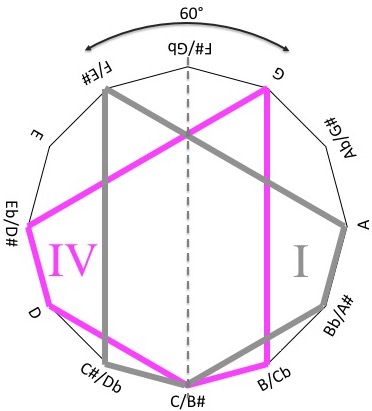
Some of the groups of contiguous notes relate to one another by 1. disregarding both the octave in which each note appears and when it appears relative to the others in the group, 2. placing each note of each group on a circle of half steps, forming a polygon, and 3. relating two polygons as either differing by a certain rotational distance or through a certain reflection.

For example, as shown below, the groups II and V have the same triangular shape, and one shape is a reflection of the other shape around an axis that falls between the notes B and C on the circle of half steps, shown with a dashed line. Music theorists call this relation inversion (I).


As another example, as shown below, the groups III and VIII have the same pentagonal shape, and one shape is, at minimum, a 150° rotation away from the other shape (allowing for either clockwise or counterclockwise rotation). When this rotation is directed, music theorists call this transposition (T).


This second example does not surprise, as the notes in group VIII are, in chronological order, all transposed down a perfect fifth from the notes in group III. The inversion of a perfect fifth is a perfect fourth, which is five-twelfths of an octave; likewise, 150° is five-twelfths of 360°.

However, as shown below, the same 150° rotational difference also relates the seven-note groups IX and X, each of which fill a full measure and have a similar single-line-then-big-chord presentation. This suggests a covert and distinctive employment of the perfect-fifth or perfect-fourth transposition, the most important transpositions in Western classical tonal music.


It stands to reason that a certain relation would be even more distinctive if it were a composite of both a certain rotational difference (one of six possible) and a reflection around a certain axis (one of twelve possible). One such composite relation occurs at least twice in this piece. As shown below, the five-note groups I and IV are related both by a 60° rotational difference and a reflection around the axis that falls on the note C, and so are the three-note groups VII and VIII.


I will leave it to the reader to find, and comment upon, two two-contiguous-note groups -- melodic intervals -- that are related by this same composite relation of 60° rotation and reflection around C. These two intervals also have the same articulation and same melodic-contour context.

Wednesday, January 31, 2018

Schubert and the Colors of Hierarchy

Franz Schubert was born 221 years ago today.

This video uses different colors to demonstrate the hierarchical embedding of pitch centers -- roots of chords and tonics of scales -- in Schubert's song "Mein!" from Die schöne Müllerin. Relationships between such centers by perfect fifths are indicated by the near-complement relation between colors, and those relationships by step are indicated by colors very similar to one another.

The small dark blue circle toward the right of the thumbnail below is immediately within a purple oval, which is within a red oval, which is within the pastel green oval. This indicates a chord that is a F#°7 chord, which is vii°7 in G minor, a key which is vi in B-flat major, a key which is bVI in the song's key of D major: thus, the chord may be understood as vii°7 / vi / bVI.

After a introduction to the graph, the video synchronizes a scrolling presentation of the graph with a performance by Genaro Mendez, to whom I am very grateful for lending his voice to this little project.


Saturday, December 2, 2017

Time Follows Pitch In "Carol of the Bells"

Below is one notation of the four-note ostinato, derived from Ukrainian folk-song literature, that serves as the basis of what later became known as “Carol of the Bells.” I have placed the ostinato in G minor, the key of multiple popular recorded versions (Mannheim Steamroller, Wynton Marsalis, Trans-Siberian Orchestra), but the key doesn't matter for what follows.
This ostinato has three properties. The first two are more common among melodies, particularly simple melodies, and they make the third more probable. Nonetheless, even with the first two properties in place, the third property is rather unusual, even for an ostinato with only four notes.

1) The ostinato uses exactly two different kinds of melodic intervals, irrespective of direction: seconds and thirds. I will call these pitch intervals one-steps and two-steps, respectively, since thirds are twice the size of seconds, generically speaking.

2) The ostinato uses exactly two different kinds of durations: some length of time and twice this length of time. (As I did above, these timespans are usually transcribed as an eighth note and a quarter note, respectively, when this carol is notated.) I will call these temporal durations one-spans and two-spans, respectively.

3) Every note in the ostinato that finishes an X-step commences an X-span. For example, the only instance of scale degree 2 comes after scale degree 3 in the ostinato; therefore, it finishes a descending-second interval, or, more generally, a one-step. Scale degree 2 is then held for a one-span. For this note, X = 1. This holds true for all four notes in the ostinato.

The diagram to the right visualizes this property. The circle shows the four notes of the ostinato, identified by scale degree (in green) and position in the triple-time meter (in red) and arranged so that clockwise order reflects temporal order. However, these notes are evenly spaced on the circle: their pitch and durational proportions are shown with the kite figures outside and inside the circle, respectively. The fact that the red kite’s position is rotated 90° clockwise from the green kite’s position means that each temporal interval immediately follows its corresponding pitch interval.

I can think of another repeating four-note motive from the music of Robert Schumann that has all three of these properties, but the shape is a rectangle instead of a kite. I’ll reveal it next month, unless someone beats me to it by identifying it in a comment below. Also below feel free to identify melodies that achieve some variation of these properties: a different number of notes, rotations by some amount other than 90° (including 0°), a non-repeating melody, absence or alteration of the first and second properties, etc.

Sunday, November 5, 2017

Some 027s in NPR's Music

If you have listened to National Public Radio, then you have probably heard many 027 chords. A 027 chord is a group of three notes that can be arranged to form a stack of two perfect fourths or two perfect fifths. These chords can be called 027 chords, because it is possible to assign those three numbers of 0, 2, and 7 to each of the notes in some register, and any two notes will differ by the same number of semitones as their corresponding numbers differ by. For example, as shown below, the group of notes B, E, and F# make a 027 because 1) they can be stacked in perfect fourths (F#-B-E), or 2) they can be stacked in perfect fifths (E-B-F#), or 3) if some E is assigned to 0, then some F# is 2 semitones higher than this E, and some B is 7 semitones higher than this E.


The chords F#-B-E, B-E-A, and E-A-D are all 027 chords. You can find all three of these chords in this passage from around the middle of Wycliffe Gordon’s arrangement of Don Voegeli’s theme for NPR’s program All Things Considered, which I’ve transcribed below. This is the arrangement that NPR is currently using for All Things Considered. The first three loud measures are typically heard uncontested in the mix, and then the remaining soft measures (which continue beyond my transcription) underlie the spoken word. The F#-B-E chord is in the muted trumpets throughout, and the B-E-A and E-A-D chords are played by the piano.

Even though this underscore is quite repetitive, it is also quite rich. The bass unfolds more unusual augmented fourths (F#-C) instead of the more standard perfect fourths (e.g. F#-C#). The return of the eight-note theme (marked "(theme)") in A major creates a clash between C# in the theme and the bass’s C natural. These two pitches reside at the two ends of a line of perfect fourths C#-F#-B-E-A-D-G-C. However, of these eight notes, the G is never sounded, even though it is the tonic of the theme in the transcription’s first two measures. The three 027 chords mentioned earlier are exactly those that fit on this line and avoid both the C and C# ends and the missing G. Moreover, just as each 027 chord is composed of three notes set in a line by a fixed unit distance of a perfect fourth, the three 027 chords of this music are also set in a line by a fixed unit distance of a perfect fourth. The diagram below, in which the double-tipped arrow represents a perfect-fourth span, shows these relationships.


Moreover, the divisions of time are quite varied and progressive: the bass line changes notes every three beats (seen easily in the page layout of my transcription), the piano chords occur every four beats, and the beat itself is divided into five parts.

NPR’s Morning Edition turns 38 today. The final moments of the NPR Morning Edition theme music, written by BJ Leidermann and arranged by Jim Pugh, express the 027 sound in a strikingly systematic and symmetrical way. An “origin story” for this music could be told using the examples below.


1: Three voices start on the same G above middle C. One leaps up by perfect fifth to D, one leaps down by perfect fifth to C, and one stays on the G to make a 027 chord, which I will mark *3.

2: These two perfect-fifths leaps are filled in with stepwise motion, but the outer voices move at slightly different rates—the top gets moving sooner, the bottom catches up later—producing an idiomatic tonal-harmonic progression: V7/IV (G7) resolving to IV (C).

3: Or, the outer voices move at the same time as they fill in their perfect fifths, producing two different three-note harmonies marked as †1 and †2. (A 027 chord stacked in fourths then precedes the same 027 chord stacked in fifths.)

4 and 5: Or, the outer voices move at very different, but still coordinated, rates to produce different 027 chords on their way to the final 027 chord. These contrasting 027 chords are marked with *1 and *2.

6: All three different 027 chords can be included in a similar progression, but this would require one of the two outer voices to give up its beeline and “dogleg” twice before getting to its final destination. In Example 6, it is the top voice that doglegs: G up to C, then down to A, then up to D.

7: The top voice’s gap between C and A could be filled in, smoothing out the top voice.

8: A transcription of the end of the Morning Edition theme. This music adds more top-voice activity to Example 7 that enables the utterance of every one of the three-note chords labeled in Examples 1-6, but in such a way that the progressions from these earlier examples are embedded within one another, as shown with the nested and overlapping slurs.

Lastly, the three 027 chords in the Morning Edition ending have the same relationships among them as the three 027 chords in the All Things Considered music: laid out in a line of perfect fourths, with the one in the middle of the line at the end of the music: